
How Custom Jewelry Wholesale Orders Are Priced
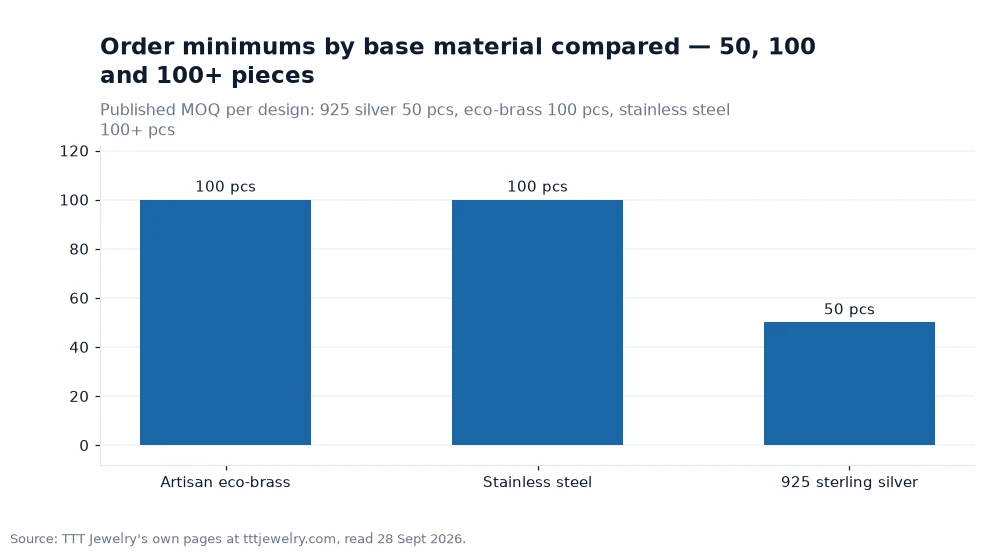
A wholesale jewelry quote is not one number, it is a stack of line items: base metal, tooling and sampling, plating, stone setting, hallmarking and packaging. Order floors are 50 pieces in 925 silver, 100 in the eco-brass line and 100+ pieces in stainless, per design, which means a two-design range starts at twice those numbers. Buyers who understand the stack stop arguing about the last line and start moving the first three.

Key takeaways
- Published minimums are 100 pieces in artisan eco-brass, 100+ in the stainless line and 50 pieces in sterling silver, counted per design, applied design by design.
- Tooling and sampling are fixed costs per design, so they spread over whatever quantity you commit.
- Four precious-metal finishes are published — 14K, 18K and 24K gold plus rhodium — with protective coatings on top.
- Six customisation fields, from base metal to packaging, each add their own quoting line.
What a quote is actually built from
Separate the variable lines from the fixed ones and a quote becomes readable. Variable lines scale with the piece count: metal, plating chemicals, stones, chains and packaging. Fixed lines do not scale at all: CAD work, mould making, the master sample and the setup of the finishing line. A buyer comparing two quotes should ask which lines are fixed per design and which are per piece, because that single question explains most of the price gap between suppliers.
The published process makes the split visible. CAD arrives in CAD CAD CAD CAD CAD 48 hours, sample 25–30 days, run 3–4 weeks. Everything in that sample block is paid once per design, no matter whether the run is 50 pieces or 500, which is why a small first order always carries a higher per-piece fixed load.
Quantity is the main lever, and MOQ sets the floor
Minimum order quantities are set per design and per material. Silver starts at 50 pieces, artisan eco-brass at 100 and stainless steel at 100+. The floor exists because tooling and setup have to be recovered on a run that still makes sense for the factory, so the floor is really a statement about how much fixed cost one design can absorb.
Anyone quoting a custom jewelry wholesale program should treat the floor as a planning constraint rather than a nuisance. Doubling a silver run from 50 to 100 pieces halves the fixed load per piece without any change to the design, the material or the finish.
The finishing stack adds its own lines
Finish options are gold in 14K, 18K and 24K with plus rhodium, protected by an anti-tarnish e-coat for silver and brass and PVD for steel.
Hallmarks are a separate line again and are applied by high-precision laser engraving: 18KGP on gold-plated work, 316L for stainless steel and the S925 hallmark on gold-plated pieces. If your packaging carries a material claim, the mark on the piece has to match it, so the hallmark decision is best made with the plating decision rather than after the sample is approved.
Six fields that move the number
The published customisation matrix has six entries: logos and hallmarks, stones and accents, material selection, plating options, chain styles and findings and packaging. Each is a line in the quote, and each is decided before tooling. A brief that fixes all six up front produces a quote you can compare with another supplier's; a brief that leaves two or three open produces a range that looks cheaper until the extras are added.
Stones and accents are the field buyers underestimate, because the setting operation is bench time rather than material cost. Natural stones and freshwater pearls are both offered, and a design with a second setting pass changes the sample schedule as well as the price.
| Quoting line | Scales with | Published anchor |
|---|---|---|
| Base metal | Piece count | Floor of 50 / 100 / 100+ pcs per design |
| CAD and tooling | Designs, not pieces | CAD inside 48 hours |
| Master sample | Designs, not pieces | 25–30 days per round |
| Plating and finishing | Surface area and stack | 14K, 18K, 24K gold or rhodium, multi-layer |
| Bulk production | Piece count | 3–4 weeks |
Worked example: three designs, two metals
Suppose a brand wants three designs and has budgeted for 300 pieces. In silver the floor is 50 per design, so 300 ÷ 50 = 6 designs' worth of minimum — the brand has room for three designs and can still raise any of them to 100 pieces. In eco-brass the floor is 100 per design, so 300 ÷ 100 = 3 designs exactly, with no room to shift volume between them.
That is the trade-off in one line. Brass spreads the same tooling cost over twice as many pieces per design, 100 ÷ 50 = 2, but it consumes the whole budget to do it. The arithmetic is mine; the floors of 50, 100 and 100+ are the published ones. Add a second sample round at 25–30 days and the cost of getting a design wrong after CAD becomes visible as a schedule problem as well as an invoice line.
Why changes after CAD are the expensive ones
Screen work and bench work are priced completely differently. A dimension change during CAD costs nothing but a revised drawing, and the drawing itself comes back inside 48 hours. The same change after the wax is printed means a new mould, a new sample and a new 25–30 day wait. This is why the published workflow puts dimensional sign-off before sampling rather than during it.
Two habits cut that risk. The first is approving dimensions against a realistic rendering rather than against a sketch, which the published CAD stage supplies by default. The second is freezing the packaging and hallmark decisions at the same gate, since artwork and laser-engraving files often arrive later than the metal specification and delay a shipment that is otherwise ready.
Frequently asked questions
Why is a small first order more expensive per piece?
CAD, mould making and the master sample are fixed costs per design, so at 50 pieces those lines spread over half as many units as the same design would at 100 pieces.
Which material keeps a wholesale program least expensive to start?
eco-brass, sterling silver at 925 and 316L stainless steel, so less working capital sits in stock.
Can I compare two suppliers' quotes directly?
Only if both quotes state the base metal, the plating stack, the stone and accent choices, the hallmark and the packaging, since those six published fields are what the finished price is built from.
Getting a quote you can compare
Send the specification before the quantity. A supplier that receives metal, finish, stones, hallmark and packaging in one message can quote the fixed lines accurately instead of guessing, and you can then test the quantity lever yourself. Review the 925 silver production route if your hero piece carries the price, and the stainless steel finishing route if the piece has to survive daily wear, because the two quotes will not be built from the same lines.
The basis for every figure above — the three service strands as well as the six customisation points, the packaging set — is the maker's own pages via tttjewelry.com, dated 28 Sept 2026. The unit conversions are my own arithmetic rather than the manufacturer's[1].