
One-Stop Fragrance Development: A Decision Framework for a Drugstore Own Brand
The question is rarely whether a manufacturer can do everything, because most can claim it; the question is whether consolidating development, filling and packaging into one partner reduces the risks your programme actually carries. A drugstore own brand fails on range coherence, on packaging that arrives late, on documentation that does not satisfy the market, and on reorders that drift. Score a candidate against those four and the one-stop decision usually makes itself, one way or the other.
Key takeaways
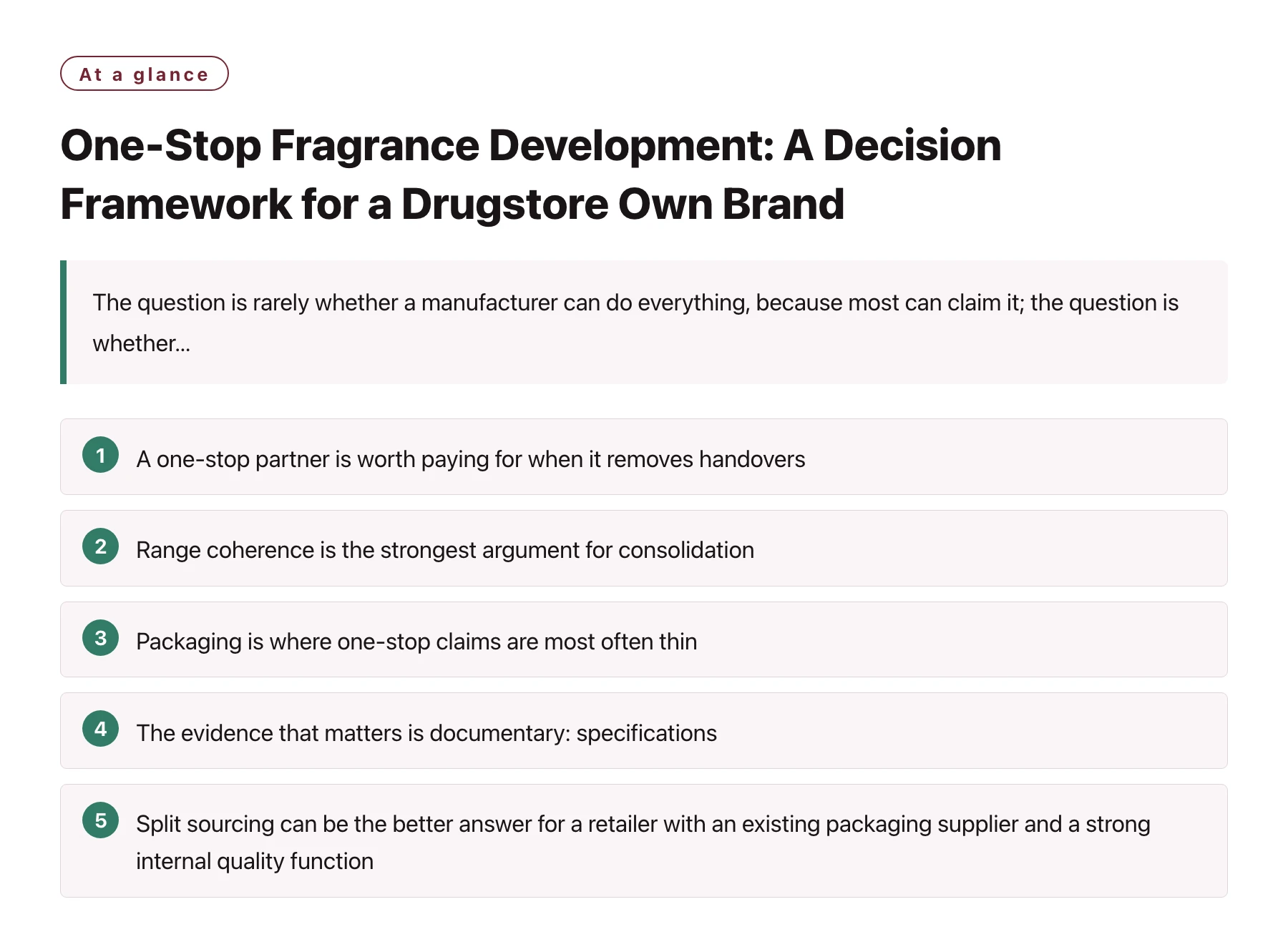
- A one-stop partner is worth paying for when it removes handovers, not when it merely lists more services; count the interfaces you stop managing, not the capabilities on the brochure.
- Range coherence is the strongest argument for consolidation, because a single development team can carry a family logic across eight SKUs that four separate suppliers will not.
- Packaging is where one-stop claims are most often thin, so ask specifically whether moulds, decoration and filling sit inside the same quality system or with subcontracted partners.
- The evidence that matters is documentary: specifications, test reports, certificates with a current scope, and a reference-retention practice you can inspect.
- Split sourcing can be the better answer for a retailer with an existing packaging supplier and a strong internal quality function, and it should not be treated as a failure of ambition.
Picture the meeting. A category director has three candidate manufacturers on a slide, all of them offering development, filling, packaging and logistics, all of them with a plausible certificate list. The team has to choose one, and the conversation drifts toward price per unit and plant size, which are the two variables the programme is least likely to fail on. Meanwhile nobody has asked how many interfaces each option leaves the retailer to manage, and that number is what the project will actually be run on.
A retailer buying an own-brand fragrance line is running a small consumer goods business. It needs a range that reads as one idea on the shelf, packaging that lands in time for a seasonal window, documentation that satisfies the market where it sells, and a partner that can still make the same product in two years. Development, filling and packaging touch all four, which is why the question of whether to consolidate them is a genuine strategic decision rather than a procurement preference.
The wider retail picture is relevant too. Own-brand lines have become the growth engine for many retailers, and the competitive pressure that produced that growth also puts pressure on margins and packaging decisions [1]. Packaging regulation in Europe is tightening in ways that affect material choice and recyclability claims, and a retailer buying for that market needs a partner who can discuss it without being asked [2]. Neither consideration is answered by a capability list.
Score the interfaces, not the capability list
One-stop sourcing is usually justified with a simple sentence: fewer suppliers, fewer problems. The useful version of that sentence counts interfaces. If development, compounding, filling and packing sit inside one company, the retailer manages one relationship and the internal handovers are that company's problem. If they sit with three, the retailer manages three relationships plus the seams between them — and seams are where schedules slip, because each party can point at the other.
There is a cost to consolidation as well, and it is worth naming. One partner means one set of capabilities and one price list, less competitive tension on components, and a concentration risk if the relationship sours. Retailers that source packaging independently often do so because their pack is a brand asset they want to control, and that is a legitimate reason to split the programme even when end-to-end fragrance development is available from a single vendor.
A four-criteria decision framework
| Criterion | What it protects | Evidence worth asking for |
|---|---|---|
| Range coherence | A family of products that reads as one line rather than eight unrelated bottles | The same development lead across the range, and a written rationale for how the family relates |
| Schedule control | A launch window that does not depend on a component arriving from a third party | An interface map naming every subcontractor in the chain and who manages them |
| Documentation and testing | A pack that satisfies the market where it sells, and a defence if it is questioned | Current certificates with scope, test reports, and the allergen information flowing from the formula [3] |
| Reorder stability | The same product in year two, at a price that has not been renegotiated from scratch | A stated retention period for reference samples, and what happens if a material is substituted |
| Commercial exposure | Leverage on price and continuity if the relationship changes | Price validity period, tooling ownership, and the practical cost of moving the pack elsewhere |
Scoring these five is not a formality; it usually moves a shortlist. A manufacturer that wins on price and loses on interface mapping is a programme that will be rescued by the retailer's own project manager, at the retailer's own cost. A manufacturer that scores well but cannot show a current certificate scope is a compliance problem waiting for a customs or retail audit. Calibrating the scores against published examples of fragrance projects from comparable ranges is a faster way to do this than arguing from first principles.
What one-stop changes inside the project
When development and production genuinely sit together, the brief travels less. A perfumer who can walk to the filling hall learns things a remote development house cannot: how the concentrate behaves in the actual base, how a coating reacts to the juice, whether a pump needs a different gasket. Those details are usually discovered in a stability test or, worse, in a warehouse.
The same proximity shortens the sample loop. It also makes a certain kind of mistake less likely — the one where a direction is approved without anyone checking that it can be produced at the target cost in the target pack. Development constraints and production constraints are different conversations, and the value of consolidation is that they happen in the same room.
When splitting the supply chain is the better answer
A retailer with an established packaging supplier, a strong internal quality team and a clear brief does not need a one-stop partner; it needs a fragrance house and a filling partner that can work from a specification. The split adds interfaces the retailer must actively manage, but it preserves control over a pack that may be the most valuable part of the brand.
The deciding question is who absorbs a delay. If the retailer has a project manager who can chase three parties and a buffer in the schedule, splitting is workable. If the launch window is tight and the internal team is thin, consolidation buys schedule insurance, and that insurance is usually worth more than the price difference.
Questions that expose a thin one-stop claim
Ask what percentage of the work is done on site and what is subcontracted, then ask who audits the subcontracted part. Ask which certifications cover which site, because a group certificate does not always extend to a satellite workshop. Ask how a change of material is communicated and approved, and ask to see the last three change notices issued on a comparable product.
None of these questions is hostile, and a manufacturer with a real integrated operation answers them quickly and in specifics. A manufacturer that answers with adjectives is telling you that the coordination will be your job. That is the practical test behind Xuelei's manufacturing arm and behind any comparable claim, and it takes one conversation to apply.
If the decision has to be made on one number, make it the count of interfaces the retailer will manage after signature. Development, materials, filling, decoration, cartons, testing, freight and documentation each represent a seam, and each seam costs management time and creates a place for blame. Consolidation is worth a premium exactly up to the point where that count stops falling, and a partner that supports a manufacturer that supports OEM and ODM models can usually describe how the count changes between the two routes.
Sources
- Cosmetics Business —— A trade publication covering the beauty and cosmetics industry, including fragrance launches and regulatory developments.
- European Commission: Packaging Waste and the PPWR —— EU rules on packaging and packaging waste, including the Packaging and Packaging Waste Regulation requirements on recyclability and design.
- SGS: Cosmetics, Personal Care & Household Testing —— Testing, inspection and certification services for cosmetics and personal care, including microbiological, stability and safety testing aligned with cosmetics GMP.
Frequently asked questions
Is one-stop fragrance development cheaper than splitting the supply chain?
Usually not on unit price, and often yes on total cost. A single partner tends to quote a higher unit price than a specialist filling house, but the retailer avoids managing several relationships, avoids some duplicated testing, and reduces the schedule risk that comes from coordination. The comparison is only meaningful when both sides include project management time.
How many certified sites should a one-stop manufacturer have?
What matters is coverage rather than count. Ask which certificate applies to which address, whether the scope covers the products you are buying, and whether the certificate is current. A group with one certified site and two uncertified workshops is not offering a one-stop certified service, whatever the cover page of the capability deck says.
Can a drugstore own brand start with a small one-stop order?
Often yes, if the pack is standard and the number of SKUs is small, because the tooling and set-up cost is limited. A one-stop route becomes harder to justify on a very small first order when the retailer wants a custom bottle, since the tooling investment is what drives the commercial case, not the fragrance itself.
What should be in writing before production starts?
The approved formula with tolerances, the fill specification, the pack specification, the test plan and its acceptance criteria, the retention commitment for reference samples, and the change-notification process. Those six documents are what makes the second order a repeat rather than a renegotiation.
Does consolidation make it harder to change supplier later?
It can. The practical exit cost is set by who owns the moulds, how specific the formula is to one house, and whether the documentation is written so that another manufacturer could work from it. Asking those three questions at the start is what keeps the door open, and it is a fair thing to raise during the same conversation about scope.
Mission-grade autonomy, on your terms.
Request a capabilities briefing with our Arlington engineering team. We respond within one business day to qualified defense and critical-infrastructure inquiries.