
One Miner, Thirty Days: A Hobbyist's First Payout Cycle
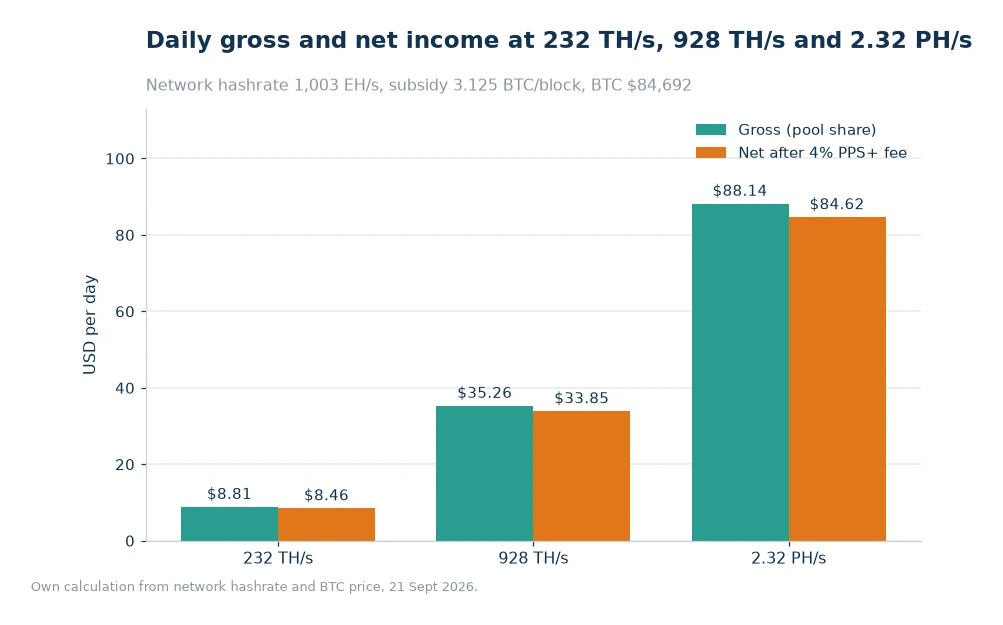
A single 232 TH/s machine returns about 0.00010409 BTC a day at current chain conditions, which is $8.82 gross and $8.46 net at $84,692 per coin. Over a first month that is roughly $237, before the electricity bill. The interesting part of the first thirty days is not the total; it is how unevenly it arrives and how much of the setup cost lands before any of it does.

Key takeaways
- Net income at 232 TH/s is about $8.46 a day, or $236.88 over a 28-day first cycle.
- Spend the first evening on firmware, pool configuration and a fixed wallet address, not on overclocking.
- A share is proof of work; a payout is a settled credit. The two appear at different times and in different screens.
- One strong week says almost nothing, because difficulty and price move independently of your machine.
What the first box really costs
The sticker price is the smallest part of the first month for most people. Add a circuit that can carry the load, a surge protector that is not a power strip, a way to move hot air out of the room, and a meter to check what the machine actually pulls. None of those items mines anything, and all of them are needed before the machine can run for a month without being babysat.
Noise is the cost that does not appear on a receipt. A single air-cooled unit is loud enough to rule out a shared wall with a bedroom. If the plan is to keep it in a flat, the first month is really a test of whether the household tolerates the sound, and that answer arrives before the first payout does.
Day one is setup, not mining
The machine will hash within minutes of being plugged in, but it will not earn anything useful until it is pointed at a pool account with the right payout address. A ViaBTC Bitcoin Mining account is the one part of the setup that must be right the first time, so create it before the hardware is unboxed. Copy the address character by character, and confirm it on the pool side before connecting the machine. A typo discovered after a week of hashing cannot be undone.
Then leave the settings alone for 24 hours. New owners tend to change frequency and voltage on the first evening, which produces two variables at once and no baseline. Run at stock for a day, record the hashrate, the wall draw and the temperature, and only then decide whether tuning is worth the risk. A 3% gain in hashrate is not worth a card that runs ten degrees hotter for a year.
The first share and the first payout are different events
A share appears in the dashboard as soon as the machine submits acceptable work. A payout is a balance change, and under PPS+ the block-reward component settles hourly against current difficulty. In the first hours the distinction is invisible; after a day it becomes obvious that the share counter moves continuously while the balance moves in steps.
This matters for expectations. Someone watching the share count expects the balance to rise smoothly and is alarmed when it does not. The balance is a series of hourly credits, each small enough to look like nothing. At 232 TH/s, one hour of net output is about 0.00000416 BTC, or thirty-five cents. Zoom out to a day and the number becomes legible.
| Week | BTC credited | USD for the week | Running total |
|---|---|---|---|
| 1 | 0.00069947 | $59.22 | $59.22 |
| 2 | 0.00139894 | $59.22 | $118.44 |
| 3 | 0.00209841 | $59.22 | $177.66 |
| 4 | 0.00279788 | $59.22 | $236.88 |
The table is deliberately cumulative in two directions: BTC credited to date, and dollars for that week alone. Mixing the two columns is a common source of confusion when a hobbyist compares a weekly figure with a monthly bill. Keep one column cumulative and one per-period, and label them clearly.
Four weeks, tracked honestly
Week one usually beats the model because the machine is new, clean and running cool. Week three usually disappoints because a difficulty adjustment lands or the room gets warmer and the fans spin harder. Neither week is a trend. The only useful comparison is the same week of the previous month, adjusted for any change in the coin price.
A simple log is enough: date, hashrate at noon, wall draw, room temperature, coins credited. Four columns and thirty rows. After a quarter it will show things no dashboard shows, such as the slow rise in wall draw as a heatsink fills with dust, or the correlation between hot afternoons and rejected shares.
Do not multiply a good week by 52
The first week often produces an annualised figure that looks excellent, and the temptation is to buy three more machines on the strength of it. Difficulty exists to prevent exactly that conclusion. Every new machine added to the network dilutes the share of the reward that any single unit receives, and the adjustment mechanism applies that dilution every 2,016 blocks.
A more honest annual figure uses a lower coin price, a higher difficulty and an uptime assumption below 100%. If the machine still looks acceptable under those three adjustments, the decision has some margin in it. If it only works on week-one numbers, it does not work.
The second machine test
Before adding a unit, check three things that the first machine taught you. Can the circuit carry twice the load without a new feed? Can the room reject twice the heat without a new fan? And did the first machine actually run for a month without intervention? If any answer is no, the second purchase will import the same problem at twice the scale.
The pool side scales more easily than the physical side. A second worker name on the same account keeps the reporting clean, and the app can watch both without a second login. The ViaBTC App is the practical way to see both machines from outside the room, which matters more once the noise makes you want to leave it.
Worked example: 232 TH/s, thirty days
The arithmetic is short, and doing it once by hand makes the dashboard easier to read afterwards.
- 450 BTC ÷ 1,003,000,000 TH/s = 0.00000044865 BTC per TH/s per day.
- 232 × 0.00000044865 = 0.00010409 BTC a day.
- 0.00010409 × 84,692 = $8.82 gross.
- Net after the 4% block-reward charge: 0.00010409 × 0.96 = 0.00009992 BTC, or $8.46.
- 28 days: 28 × 0.000099924 = 0.00279788 BTC, which is $236.88.
- Power at 4.6 kW and $0.07/kWh: 110.4 kWh × 0.07 = $7.73 a day, or $216.44 over the cycle.
- What remains after power: $236.88 − $216.44 = $20.44 for the month.
Frequently asked questions
What does one 232 TH/s miner return in a month?
About 0.00279788 BTC net, or $236.88 at $84,692, over 28 days of continuous hashing after the 4% charge on the subsidy part.
Why is my balance not moving even though shares are accepted?
Shares are submitted continuously while PPS+ credits are settled hourly, so the balance steps rather than flows; at this hashrate each hourly credit is roughly 0.00000416 BTC.
Should I overclock on the first day?
No. Run at stock for 24 hours to record hashrate, wall draw and temperature, because changing two variables at once leaves you with no baseline to judge whether the tuning helped.
Give it a month before you judge it
Thirty days is long enough to see a difficulty adjustment, one hot spell and one electricity bill. That is the minimum evidence base for deciding whether to keep the machine, move it somewhere cheaper, or add a second one. The Profit Calculator is the right tool for re-running the numbers at the end of the month, and the notes you kept are the input it cannot guess.
Sources: ViaBTC pricing, calculator and app pages, plus chain data read 21 Sept 2026 — network hashrate 1,003 EH/s, difficulty 132.76 T, 3.125 BTC per block, 144 blocks a day, BTC $84,692. Power draw and tariff in the final step are illustrative assumptions. Published 24 Oct 2026[1].